
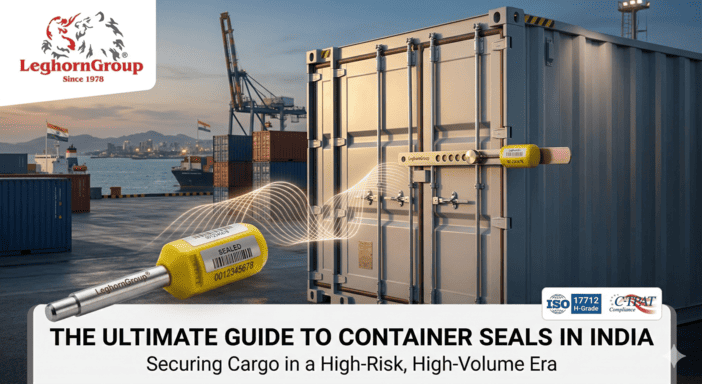
The Ultimate Guide to Container Seals in India: Securing Cargo in a High-Risk, High-Volume Era
As we navigate 2026, India's logistics and export sector is breaking all previous records. According to the Ministry of Ports, Shipping and Waterways, India's major ports handled a staggering 915.17 million tonnes of cargo in FY2025–26, surpassing their targets with over 7% year-on-year growth. Heavyweight ports like Deendayal, Paradip, and Jawaharlal Nehru Port Authority (JNPT) are operating at maximum capacity, managing immense volumes of TEUs (Twenty-Foot Equivalent Units).
However, this phenomenal scale brings unprecedented risk. With higher volumes and complex, extended transit routes, protecting valuable cargo from theft, tampering, and international smuggling is no longer just an operational task—it is a critical boardroom priority for Indian exporters.
This comprehensive guide dives deep into the world of transit security. We will explore the types of seals available, the escalating risks of organized cargo theft in Asia, the non-negotiable importance of international standards, and why advanced electronic tracking is becoming mandatory under modern Indian Customs policies like the "Turant Customs" program.
2026 Cargo Theft Report: A Staggering ₹12,000 Crore Problem
According to the latest 2025/2026 supply chain risk and cargo theft reports, the nature of cargo crime has evolved from opportunistic pilferage to highly organized, commercial operations. The numbers for the Indian subcontinent are alarming:
- The Regional Hotspot: India now accounts for a massive 63% of all cargo thefts across Asia, followed distantly by Indonesia and China.
- Financial Impact: Cargo theft is costing the Indian economy an estimated ₹12,000 Crore annually. Globally, cargo theft losses surged by 60% in 2025, reaching nearly $725 million.
- Top Targets: Thieves are heavily targeting food and beverage products, agricultural goods (like rice, sugar, and edible oil), metals (driven by high copper prices), and enterprise electronics.
- Modus Operandi: While hijacking and facility thefts remain common, organized syndicates in India are increasingly utilizing "fictitious pickups"—using fraudulent documentation and doctored digital freight platforms to steal entire FTL (Full Truckload) shipments.
What Exactly is a Container Seal?
A container seal is a heavy-duty, tamper-evident security device used to lock shipping containers immediately after they have been loaded and inspected at the factory or warehouse. Once locked, these high-security seals cannot be removed without being permanently destroyed—usually requiring specialized heavy-duty bolt cutters.
This destruction acts as visual and physical proof. It ensures that the receiver, customs agents, and logistics managers know exactly whether the cargo was breached during its journey from an Indian factory to its destination port in Europe, the US, or the Middle East.
Essential Tamper-Evident Solutions for Modern Freight
When sourcing the right security solutions to combat the risks outlined in the 2026 theft reports, Indian exporters and freight forwarders must rely on globally recognized shipping container seals. For international maritime shipping, high-security bolt seals remain the absolute gold standard. These robust devices consist of a heavy-duty metal pin and a locking barrel engineered to resist massive physical force, high-speed spinning, and unauthorized cutting tools.
However, simply deploying a heavy metal lock is no longer sufficient for global compliance. Regulatory bodies and cross-border customs agencies strictly demand the use of ISO 17712:2013 certified seals. This rigorous international standard defines the precise physical and mechanical strength required for top-tier tamper-evident seals. For a seal to earn the highly coveted "High Security" (H) classification, independent, accredited laboratories must test it vigorously against impact, shear, bending, and tensile pull loads.
For domestic logistics, intrastate rail networks, or specialized freight, cable seals offer incredible versatility. Made of a braided steel aircraft cable that can be pulled tight, they are excellent for securing irregular locking mechanisms on road trucks passing through state borders or for securing chemical valves and industrial drums. Furthermore, the push for digitalization by the Central Board of Indirect Taxes and Customs (CBIC) has made RFID container seals (e-Seals) and other electronic customs approved seals vital for automated port entry and exit, fundamentally transforming the landscape of cargo security in India.
The Crucial Role of ISO 17712:2013 Certification (Clause 5 & 6)
If you are exporting goods out of India to strict regulatory markets, compliance is not optional. Initiatives like the US C-TPAT (Customs-Trade Partnership Against Terrorism) and the European AEO (Authorized Economic Operator) programs mandate that all incoming containers be secured with a seal that meets or exceeds the ISO 17712:2013 standard.
However, it is not enough for a seal to just "look" strong. True ISO compliance requires two distinct clauses:
- Clause 5 (Physical Strength): The seal must pass rigorous mechanical testing to be graded 'H' (High Security).
- Clause 6 (Tamper Evidence): The manufacturer must be audited to prove that their seals leave definitive visual evidence if tampering is attempted, even utilizing advanced techniques like heating or freezing.
At LeghornGroup, our flagship NEPTUNESEAL is a prime example of an elite solution. Fully compliant with both Clause 5 and Clause 6, the NEPTUNESEAL features a metal insert housed in shatter-resistant plastic. Its anti-spin locking mechanism ensures your high-value cargo remains completely secure against sophisticated tampering attempts.
The Rise of RFID e-Seals & Indian Customs Digitalization
One of the most transformative changes in the Indian export landscape has been the CBIC's push toward total digitalization under the "Turant Customs" (Faceless Assessment) program. To promote the "Ease of Doing Business," Indian Customs allows approved exporters to self-seal their containers at their own premises, completely bypassing the need for a jurisdictional customs officer to be physically present.
The catch? The exporter must use an officially certified RFID e-Seal.
Why are RFID e-Seals essential for Indian Exporters?
- Frictionless Port Clearance: RFID scanners (UHF frequency) installed at Indian port gates automatically read the e-seal's data as the truck approaches. This eliminates manual paperwork checks, drastically reducing truck queuing times and minimizing port congestion.
- Absolute Data Integrity: The microchip inside the seal holds encrypted, unalterable data about the exporter, the cargo, the invoice number, and the destination.
- Tamper Evidence on the Fly: If the mechanical pin of the seal is cut or tampered with during transit, the RFID chip antenna breaks, instantly changing its digital status. When read at the port, it immediately alerts the Electronic Cargo Tracking System (ECTS) and flags the container for 100% customs inspection.
LeghornGroup is a global pioneer in RFID tracking technology. Our tracking solutions combine the brute mechanical strength of traditional ISO 17712:2013 seals with cutting-edge electronic data transmission, providing a seamless bridge between physical security and digital compliance.
How to Choose the Right Seal for Your Cargo
Selecting the correct tamper-evident seal depends entirely on your specific logistics route, mode of transport, and cargo type:
| Logistics Scenario | Recommended Seal Type | Key Benefit |
|---|---|---|
| International Ocean Freight (Export) | RFID Bolt Seal or ISO 17712 High-Security Bolt Seal | Mandatory for CBIC Self-Sealing and C-TPAT compliance. |
| Domestic Road & Rail Freight (DFC) | Adjustable Steel Cable Seals (3mm - 5mm) | Flexible fit for varying truck latches; prevents highway pilferage. |
| Chemical Drums & Specialized Valves | Metal Strap Seals or Light Wire Seals | Custom lengths accommodate non-standard locking holes. |
| Courier & Air Cargo Totes | Indicative Plastic Pull-Tight Seals | Cost-effective, highly visible tamper evidence for fast-moving goods. |
Why Trust LeghornGroup India for Your Security Needs?
With a rich legacy dating back to 1978, LeghornGroup has evolved into a global titan in anti-tampering solutions. Through our dedicated regional branch, LeghornGroup India, we bring decades of European manufacturing excellence, rigorous ISO 9001 quality control, and technological innovation directly to the Indian subcontinent.
We do not just manufacture plastic and metal; we engineer complete security ecosystems. From uniquely laser-numbering and barcoding mechanical seals to providing robust, integrated software APIs for our RFID devices, we ensure your supply chain remains impenetrable—from a manufacturing floor in Pune to a massive distribution center in Rotterdam.
Secure Your Supply Chain Today
Do not leave your valuable cargo vulnerable to 2026's surging transit risks and sophisticated organized crime. Comply flawlessly with international C-TPAT standards and Indian CBIC customs regulations with LeghornGroup's premium container seals.